My husband and I are big fans of the long form YouTube essay. Recently we watched a suggested video by Gavin the Medievalist entitled “Our Cultural Memory of the Middle Ages,” where he spells out the difference between the historical Middle Ages and Medievalism. Basically, people have been constructing narratives about that time period since it ended, continuing to reexamine the history through a many-layered lens of not just history but prior interpretations and narratives.
This happens with all periods that have happened to snag the collective imagination. This phenomenon is not avoidable, and I’m not sure there’s anything precisely wrong with it, so long as we recognize it for what it is. We can try to be as “historically accurate” as possible, but sometimes well-researched historic accuracy clashes so blatantly with our shared cultural understanding of at time it reads anachronistic. For instance, would you set a movie in ancient Rome and paint the temple walls and pillars vivid colors? It’s a choice you as a creator have to make.
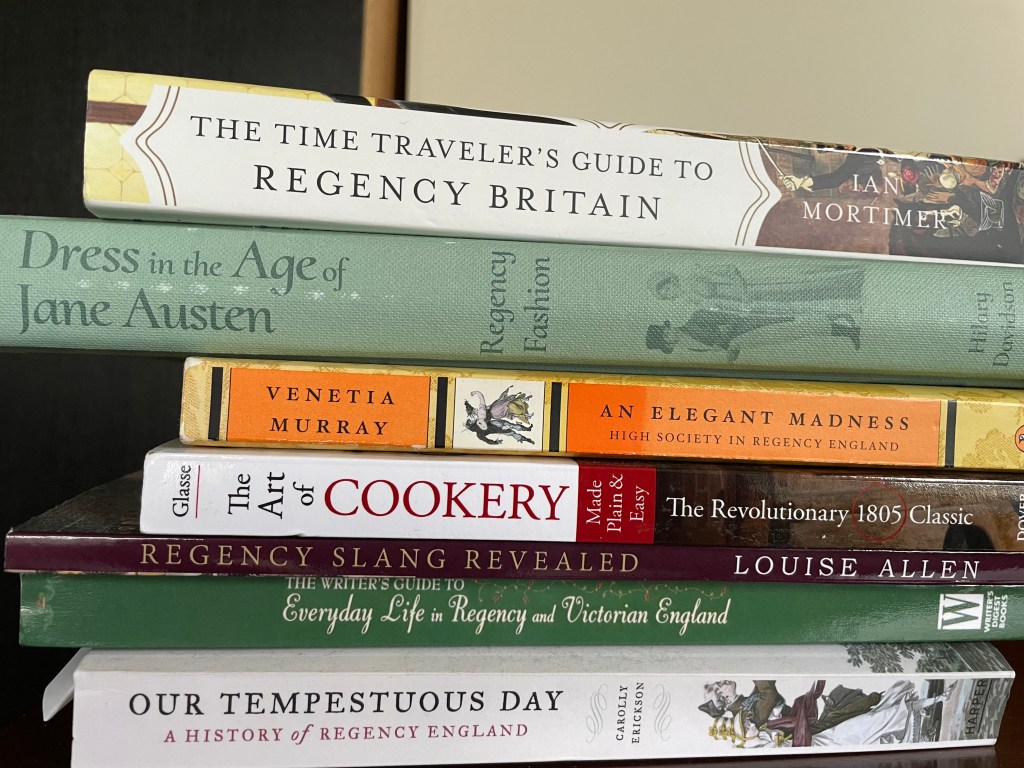
One of my current WIPs is a Regency fantasy, and so the Medievalism video immediately made me think of “Regency-ism.” (Now, perhaps there’s a better term, or at least a better spelling, but I digress.) Like Ancient Rome or the Middle Ages, the Regency period continues to surface in the cultural zeitgeist. Right now we have Bridgerton to thank for bringing it to the forefront, and Shonda Rhimes’ adaptation proudly takes all sorts of liberties with “accuracy.” Having done a decent amount of research for my own project, I would argue the biggest fantasy in any Regency movie or TV show is the fact all the characters seem to bathe and brush their teeth with any regularity…
This is my first time writing anything in the historical vein, and even though the fantasy element gives me extra leeway, I am trying to don my historian hat. I do think it’s fun when fans break down the historical accuracy of a certain dresses or sword fight, but at a certain point one has to let go and give into the -ism of it all.
One of the biggest rabbit holes I’ve fallen down thus far is on the matter of dance cards, which are an incredibly useful and fun narrative device (evidenced by their presence in all sorts of modern books/movies/shows), but which might not have been in wide use until decades after the Regency. So, dilemma: I want to use dance cards, but they’re not historically accurate. But they are accurate to Regency-ism.
And I can’t write a story today with the same cultural understanding and prejudices of two hundred years ago. Some things ought to be left firmly in the past, especially classism, sexism, racism, colonialism and those other evil -isms. But the more you try to drop those, the more divorced you become from the historical reality. Which might be okay.
There are all sorts of people, places, and time periods that have some basis in history but have since grown into a popular understanding in our imaginations and media: Ancient Rome, Medieval Europe, ninjas, pirates to name a few.
I enjoy studying history and will continue to do so, and I also find value in studying the lenses we put over it. As we keep telling ourselves stories of our past, we simultaneously tell the stories of who we are right now.
—————————
Recent reads:
This Way Up by Jay Foreman and Mark Cooper-Jones
Half His Age by Jennette McCurdy;
I Who Have Never Known Men but Jacqueline Harpman (translated by Ros Schwartz);
Lost Souls Meet Under a Full Moon by Mizuki Tsujimura (translated by Yuki Tejima)

 Elizabeth Gootzeit
Leave a comment